
Introduction
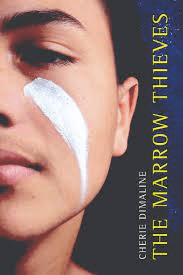
The Marrow Thieves by Cherie Dimaline is a YA Indigenous, futuristic, dystopian novel. The text delves into an assortment of themes including humanity, dreams, community, and fear. It is a coming of age novel that follows Frenchie, an Indigenous teenager on the run from the recruiters, or Marrow Thieves. Despite the title, the novel is central to Frenchie, his chosen family, their relationships, and their backstories; not the recruiters themselves. The story takes place on a continuous journey, and jumps back in time with “coming-to” stories that give context as each character is introduced and developed. The Marrow Thieves is an important text with plentiful concepts to examine, and critical thinking to be evoked.
About The Author
Cherie Dimaline is a member of the Metis Nation of Ontario, the federally and provincially known representative government for her community. Specifically, Dimaline is from the Historic Georgian Bay Métis Community with section 35 Indigenous rights. Her last name comes from her father, who is French and Canadian. From her website, Dimaline says “My family has always had each other and everyone was fed and loved. It was beautiful. Difficult at times for many reasons, and we passed along anxiety as well as stories, but beautiful none the less.” Dimaline believes in making space for others, speaking only for herself, and acknowledging her identities in her work.
Characters
Frenchie is a stubborn and kind kid. When he gets separated from his brother, he has nothing. He finds Miigwans and the group that he comes to be a part of. Frenchie’s name comes from the people before him; hunters, trappers, and voyageurs. His name comes from his Euro-American side, as well as from his Indigenous roots. Named Francis at birth, Frenchie was inspired from there. Frenchie, or French as he is often called, prides himself on having the longest hair, something that connects him to his Indigenous family. He says,
“I braided it myself each morning, to keep it out of the way and to remind myself of things I couldn’t quite remember but that, nevertheless, I knew to be true.”
Page 21
Wearing his braids helps him feel a connection to his culture and identity. Frenchie and his chosen family wear their braids to keep tradition alive. They’ve lost so much of their culture, this feels significant to them. Frenchie is undeniably the main character, and is the most developed throughout the course of the text.
Migwans is the leader of the group. Besides Minvera, their elder, he is the oldest. Miig is constantly evaluating everyone’s safety and surroundings. He always knows what to do, or which person will have the appropriate strengths and intuition to. Before he came to travel with his group, he lived with his husband, Isaac. Losing Isaac was beyond devastating for Miig. He says,
“Isaac was a poet, you see, and in the adversity the words kept coming. In some ways we were still happy. Isaac had his words, both English and Cree, and I had my Isaac.”
Page 100
Isaac was always the center of Miig’s world, and his heart collapsed when Isaac was taken. Miig kept what he thought he had of Isaac, a vial, against his heart through the novel. Frenchie says,
“Once, when I’d asked him, he’d told me that was where he kept his heart, because it was too dangerous to keep it in his chest, what with the sharp edges of bones so easily broken.”
Page 20
Isaac also held language, English and Cree. Cree language was dwindling, and it was significant to have people who knew it to share their knowledge. Miigwans mentions Isaac throughout the book, which foreshadows how significant he is in the ending.
Rose is a powerful, and underdeveloped character. She joins the group shortly after Frenchie, and they fall in love over the course of the book. The group adores her, saying
“And we loved the way she rebelled, anyway; having been raised by old people, she spoke like them. It made us feel surrounded on both ends – like we had a future and a past all bundled up in her round dark cheeks and loose curls.”
Page 32
The novel is strongly centered around Frenchie, and Rose’s character doesn’t seem to have much room for growth. Frenchie says about Rose,
“She made me feel like I needed to be a better person just through her existing.”
Page 32
Rose has this essence of understanding and persistence. Rose and Frenchie’s relationship is more subtle, and that feels intentional. Their inevitable love feels promising and deliberate, making a specific scene about them in the ending all the more significant. Rose waits for Frenchie, having a hunch that he will follow. She says, “A hunch. And a lot of hope.”, (Page 218) which shows that the relationship is reciprocal, something that wasn’t always clear due to the focus only on Frenchie. The scene is bittersweet and romantic, the perfect note to leave off on their relationship.
Themes
As a group, they discuss whether people make circumstances bad or if bad circumstances make people bad. This theme is present throughout the novel. While you don’t get insight into the Recruiters thoughts and experiences, it’s curious how the dynamic came to be. I believe that circumstances are made bad by people, not vice versa. I don’t believe in the concept of “bad people”, and I believe in the internal power we have over external happenings. In the text, they converse on the topic of changing for the better when affected by circumstances only if you are a “good person”. The idea that “good people” will change for the better, while “bad people” will change for the worse under whatever circumstances. In the novel, one of the group members and Miigwans have an exchange during the group discussion. Referring to the recruiters, it’s asked
“So we’re the same?”
Miig responds, “‘In a way.’
‘So then I’m right. If we’re both motivated by the same thing and they are the ones hurting people, then that’s their nature, they’re bad to begin with.’”
Page 54
I believe that every being has inherent worth, and that people change and stray away from their “goodness” for a variety of reasons and experiences. In the novel, they touch on the idea of being similar, all motivated by survival, and why the recruiters are the ones making the terrible and harmful actions: because they are “bad people”. What is a “bad person”? Is it just someone who makes bad choices, continuously? Someone who follows along with others’ bad choices? How many chances for change does someone get? Miig says,
“I think it’s more like you do what you need to in order to keep yourself intact. It’s about motivation.”
Page 54
Story is an ongoing theme in the novel. Story, as it’s titled, is the sharing and telling of history and experiences. Coming-to stories are someone’s story of how they came to be where they have landed. Miigwans tells story on many occasions throughout the book. He speaks about suffering at the first schools, and suffering with the pain that came afterward in the form of pills and office jobs. He goes on to say,
“But we sang our songs and brought them to the streets and into the classrooms – classrooms we built on our own lands and filled with our words and books. And once we remembered that we were warriors, once we honored the pain and left it on the side of the road, we moved ahead. We were back.”
Page 24
The significance of story is perseverance. Story educates from experience and shares perspective amongst ages and identities. It informs, then inspires action to be taken, and resistance to be had. Resistance is present in the form of relearning cultural practices, that are also recovered through story. Story represents that they’ve persevered before, and that they can again. Sharing story is a way to keep tradition and language alive. Language is something they all feel is important, and they want to relearn and reclaim it. At first, Frenchie doesn’t think much of their elder; that is until he learns she has language. When he learns one word from Rose, Nishin, he says
“I turned the word over in my throat like a stone; a prayer I couldn’t add breath to, a world I wasn’t willing to release.”
Page 39
From the first chapter, death is a prominent theme in The Marrow Thieves. On page 13, Frenchie says aloud to himself “I’m going to die.” Clearly, he doesn’t die; that would make for an awfully short novel. It is a valid and continuous fear. Throughout the novel, they experience heartbreak after heartbreak from the death of lives and parts of their lives. Mourning isn’t just from the death of people they cherish, it’s of change and language and tradition. For over half the novel, Frenchie had only been on the other side of the killing. The ones being killed. He eventually landed in a position where he made a choice out of anger. He killed a recruiter because they killed someone he cherished. After the blur of deaths, Frenchie thinks,
“Something had changed since I’d fired the gun, since I’d killed Travis. It was like a color had ceased to exist and now the world seemed dull.”
Page 139
His anger caught up to him and he wanted Travis to feel the hurt he did. Frenchie knew under the anger that he would regret it. Afterwards, the world seemed dull and irreversible. Life is so important to every one of them, even if it’s a life spent fearing and anticipating death. Chi-Boy, a member of their group, says
“‘Sometimes you risk everything for a life with living, even if you’re not the one that’ll be alive to live it.’”
Page 152
This shows how persistent and dedicated each one of them are to justice and joy. They will do everything in their power to make the world more livable for each other, even if they won’t get to experience the effects. The afterlife isn’t explicitly discussed in the novel, however, there is a scene that hints at the idea. When Minvera dies she says Kiiwen. Frenchie doesn’t know what this means, but Rose does. Rose tells him,
“‘Kiiwen, Frenchie. You must always go home.’”
Page 211
At this time, Minerva has accepted her next state and welcomed it. She is going home, maybe somewhere better than the mess of the world they live in. After Minvera dies, Frenchie sends something he immensely cherishes treasures with her, his braid. This is significant, Frenchie says,
“I hadn’t felt so vulnerable since the day Miig had found me, half dead, sick from spoiled supplements, hallucinating.”
Page 213
There is so much death, and they honor it all.
Writing Style
The Marrow Thieves has a unique writing style. At first, I felt uninterested by it. The beginning was slow and offered an ineffective balance or context and actual story. I felt that Dimaline used too many literary devices, and that all the background information was tedious and longer than need be. After the initial introduction, the novel took a drastic change in pacing. There was some heavy foreshadowing and the pacing sped way up. I felt that the pacing was unbalanced and weirdly distributed throughout the novel. The middle section became much more absorbing, however, you have to drag through the beginning to understand it. Towards the end, the pacing evened out. The descriptive writing and storytelling became engaging and interesting without the mundane introduction and background. I felt yanked around by the pacing of the book and I wish it would have been delivered more evenly. If I hadn’t read this for school, I might not have even continued past the beginning part. The novel lacks a hook for the readers to be drawn in by. However, once the pacing evens out, the writing is beautiful and touching. I cried a lot during the ending due to how impactful and elegant the writing is.
Should This Book Be Taught in Classrooms?
I think this book was one of the better books taught in classrooms, and I am still disappointed in the curriculum we are given. The Marrow Thieves provided some impactful themes and characters, as well as representation. It also felt like a strange book to read in a classroom setting. The book focuses on the idea that there is a reality that in the future the world will be destroyed and Indigenous people will be killed, seen as more worthless than ever. This is very depressing. It feels like an inspiration for change that needs to happen now, and that message is mostly through fear. The novel has Indigenous and some smaller queer representation. Reading it in schools supports an author of marginalized identities. All of those are so important, and I think this wasn’t the best book for school. Last year, we read The Absolutely True Diary of a Part-Time Indian, a novel by someone who was not a good choice to support. School curriculums are trying to branch out from old cishet white guys, and while they are doing that, they aren’t fulfilling their opportunities. Seeing representation in classrooms is crucial for students, and I hope we can move much further in that direction. For more on banned books and representation, visit my blog posts here and here.
Conclusion
While this novel was not something I would have read on my own, I did enjoy parts and find important aspects to it. I would recommend this book to anyone who desires a fancifully written YA dystopian novel with Indigenous and queer representation. This book wasn’t quite for me, although I am glad I read it and was able to branch out. I could see it being enjoyable for people who do enjoy these genres. In the end, there is value in everything we consume, and that value is also dependent on the setting we consume it in. It was still significant, grew critical thinking, provided representation; and the value of this novel could have been more outside of the classroom.


7 responses to “The Marrow Thieves by Cherie Dimaline (Book Review)”
ty
LikeLike
Thanks for sharing this well-written review about a book I otherwise would unlikely have become aware, Bram. -Gpa
LikeLiked by 1 person
Thanks for reading! Glad you enjoyed it (:
LikeLike
I feel quite the same way about this book, great job on this detailed review!
LikeLiked by 1 person
Thank you! I’m glad you could resonate
LikeLike
Good nuanced review. I like how you balance what you liked and what you didn’t like with compelling arguments.
LikeLiked by 1 person
Thanks for reading and for the feedback!
LikeLike