
About the Author
Shaun David Hutchinson is an outstanding and impactful author. His Young Adult novels never fail to authentically resonate. Hutchinson’s memoir, Brave Face, is striking and genuine. He integrates themes and experiences of his past into his fictional writing. Speaking about writing for teens, he writes “You can’t pander to them, you can’t talk down to them, and you can’t sugarcoat anything. All you can do is be honest, which is what I try to do when writing about mental illness.” (Page 488, Author’s Note) This approach to writing nurtures the most honest and touching aspects of representation for young people.
Summary
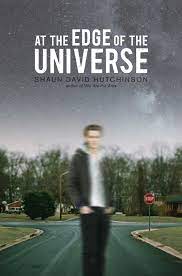
At the Edge of the Universe is a compelling story about teenage Ozzie Pinkerton. Tommy, Ozzie’s boyfriend, disappears from existence and everyone’s memory. Ozzie remembers Tommy, just as he remembers the stars, the sun, the moon, and the rest of the world. It’s all gradually vanishing. Everyone’s memory adapts these changes, altering for everything to make sense; as if it’s never been any other way. Ozzie remembers it all, and doesn’t know how to stop it from evanescing.
While all of this is in play, Ozzie’s brother is getting ready to join the Army and his parents are going through a divorce. His best friend Lua’s music is growing in popularity, and they’re becoming busier. While a therapist could be a constant in his life, Ozzie is unwilling to accept help and moves from therapist to therapist often.
Characters
Lua is a genderqueer upcoming popstar who is determined to be self-reliant. Their gender expression isn’t a main aspect of the story, but is discussed occasionally. Hutchinson effectively represents genderqueer kids in his literature as part of the cast of characters, including gender expression as part of everyday life. The representation of genderqueer kids is crucial. They don’t have to be main characters to have things going on with their gender and expression. It doesn’t have to be a focus of the plot.
Similar to how Lua’s gender expression is presented, Ozzie had never questioned if he was queer until his best friend of many years asked to kiss him. And then he knew; he was gay and he was in love with Tommy. Sometimes sexuality and gender aren’t extensively questioned, they unfold.
Ozzie gets a mistaken impression that his classmate Calvin remembers Tommy too. After chasing Calvin down, Ozzie realizes his mistake. Calvin and Ozzie begin to grow closer together through a shared science project. Calvin deals with depression and past experiences that haunt him. Ozzie eventually is able to assist him in getting help and reporting those who wronged him. Ozzie doesn’t want to betray Tommy, in case he comes back, but he finds himself liking Calvin. He’s conflicted, and has to learn to prioritize himself. Calvin challenges Ozzie to stand up for himself and others, accept the good things that come to him, and form valuable connection.
Ozzie’s parents haven’t really been together since their lives began to drift apart and neither of them stopped it. While they are only now divorcing, it’s been coming for a long time. Ozzie is confused and takes sides, until he learns more about his parents wrong-doings and has to rethink. He struggles to accept that what once worked won’t always work in a world full of change.
Therapy and Accepting Help
Ozzie makes his way through therapists, giving his now rehearsed speech about Tommy, the plane crash that would have killed him if he hadn’t been taken off the plane for being underage, his parents, Lua becoming famous, and the shrinking universe. Oftentimes he doesn’t even make it through the full session before he leaves. One therapist asks him if he will accept help. When Ozzie’s says no, the therapist says goodbye. Ozzie begins to realize that he had to be open to receiving what is being given to him. Another therapist asks him what he would do if the universe wasn’t shrinking. Ozzie is silent. He realizes he would still be there, in Cloud Lake, even if the rest of the world were there too. Through his time with various therapists, he begins to open himself and inch closer to the events of the conclusion.
Identity (in YA Fiction)
Identity is a common theme for YA literature. Teens are in their most developmentally impactful periods of their life. Books help to explore and validate that. Ozzie is composed only of other people. He feels so dependently made up of them; he doesn’t know who he is. He finds himself struggling to define who he is when everyone he loves is taken out of the equation. He had spent almost all of his energy and focus on finding Tommy. This quote from the novel examines that idea,
“It’s impossible to let go of the people we love. Pieces of them remain embedded inside of us like shrapnel. Every breath causes those fragments to burrow through our muscles, nearer to our hearts. And we think the pain will kill us, but it won’t. Eventually, scar tissue forms around those twisted splinters like cocoons. They remain part of us, but slowly hurt less.”
This becomes a prominent theme in the ending as Ozzie begins to move towards healing.
The Conclusion
The ending of this book was perfect; everything paid off and wrapped up in a beautiful and sorrowful way. I could feel throughout the novel that the main plot was metaphorical for something, and I stayed unsure of what exactly until it unraveled in the last few chapters. Ozzie’s focus on Tommy was covering up the truth and emotion of the situation. Ozzie felt a lot of things about Tommy’s disappearance, but never touched into his real feelings. He denied parts of the situation and of his memory. His selective memory intensified so much so that another reality that was closing in on him, until he faced truth and acceptance. That metaphor was flawlessly completed in a touching and real way, even with the sci-fi aspects. Ozzie spent a lot of time setting his life up around the possibility of Tommy returning. He is afraid of opening new doors, and by doing so, closing others. He comes to a conclusion,
“Maybe some doors that slam shut behind you and can’t ever be opened again aren’t the scariest things in the world after all. Maybe some doors are better off closed. That way we can focus on the ones still open in front of us.”
Sci-Fi Elements
In most of Shaun David Hutchinson’s books, he explores the intersection of sci-fi and realistic storytelling. I found At the Edge of the Universe particularly compelling because it wasn’t directly specified what the reasoning or truth to the sci-fi events were. I initially expected aliens to come up, but they weren’t included. It was enough to present as a metaphor of Ozzie’s mind, and to be left partially unexplained, giving the reader room for critical thinking and analysis.
At Its Core
The universe of our minds can feel so real and intense. In Ozzie’s case, so intense it alters all reality. At it’s core, this novel is about acceptance of others and ourselves. My other favorite Shaun David Hutchinson book is somewhat the opposite. A Complicated Love Story Set in Space is central around love, connection, and being in relationship with others. The main moral of At the Edge of the Universe is about self acceptance and love. Shaun David Hutchinson is able to skillfully approach all of these opposing and similar concepts in sci-fi YA fiction. Self acceptance is important for everyone, and specifically for the main audience of teens. It pairs with identity. This novel embodies all of these themes in a crucial and engaging manner.
Grief presents itself in many places, other than death. Grief is central to Ozzie’s story. Ozzie has lost his relationship, his parents’ relationship, part of his best friend, the universe. He is facing so much change, and the universe is drastically shrinking. Everything becomes so overwhelming to the point when Ozzie finally breaks. He faces everything, specially his avoided grief. Grief is an essential theme that is discreetly present throughout the novel, and comes through more vividly in the ending.
Final Thoughts
This novel is simply beautiful; and so intensely complex. It’s unlike any YA Fiction I’ve read. At the Edge of the Universe embodies many themes, values, and conclusions. It challenges reading comprehension throughout the novel, and pushes for critical thinking surrounding the ending. This book resonated with me, brought me joy, had me in tears, and was impactful. There are many themes, quotes, concepts, and characters to dissect from At the Edge of the Universe, and I hope this was a somewhat complete analysis.
 Bram the Bookworm
Leave a reply to Bramwell Stryk Cancel reply